
Would You Work for You? | Glenna Hecht, Leadership Strategist & Author | The Jeff Crilley Show
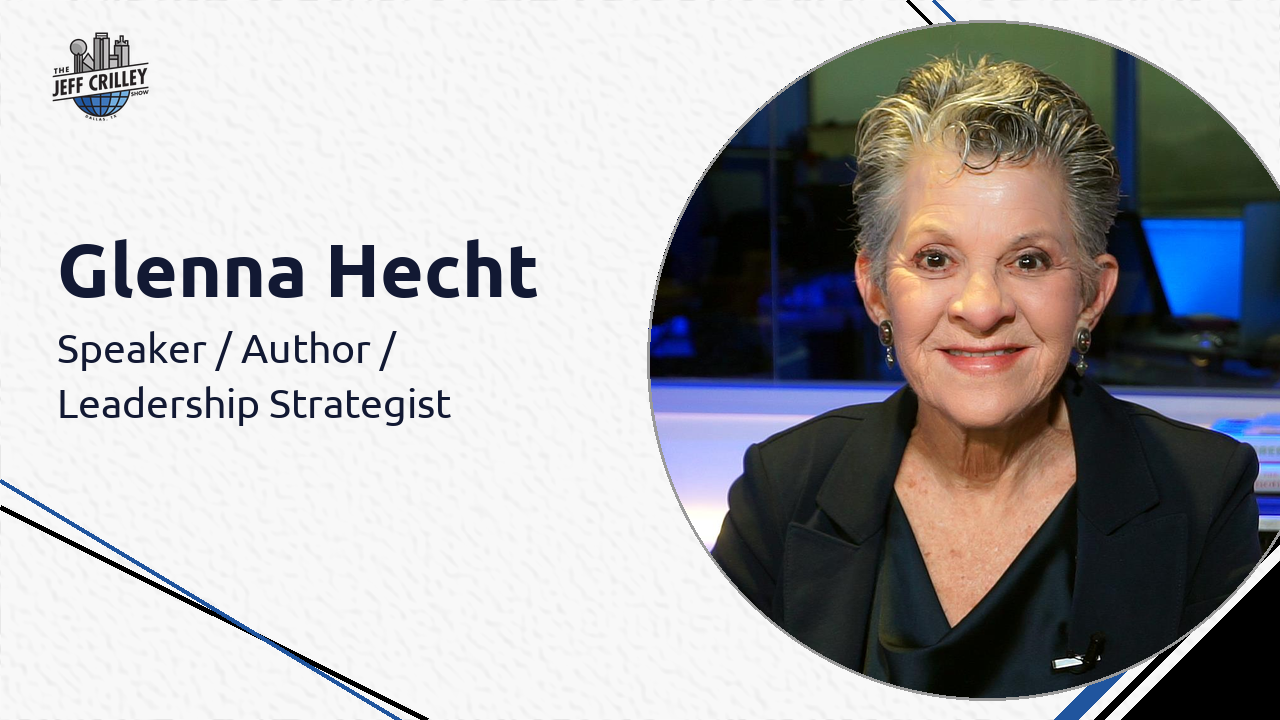
Leadership strategist and author, former HR executive and dementia caregiver, tells Jeff in the studio how a playful question rescued her nine-year caregiving journey and became the subject of a deeply personal memoir.
A Tour of Her Own Room
Picture a grown woman sitting in her elderly mother's home while her mother — deep in dementia — walks her through the house, room by room, like a real estate agent showing a new listing. They stop at one doorway. "This is my daughter's room and she's a slob," the mother announces. The daughter sitting beside her is that very slob, decades older now, trying not to laugh.
That moment, both hilarious and heartbreaking, captures the strange gift that leadership strategist and author first discovered only after she stopped fighting dementia's logic and started living inside it. The story of how she got there — and the two years of failure that preceded it — says as much about leadership as it does about caregiving.
From Theater to the C-Suite
had come out of theater when she landed her first corporate role in training and development. "Training felt like the business part of theater," she told Jeff. She was good at it, working for several large companies, until a boss pulled her aside with a suggestion that sounded like bad news. "We want you to go into HR. We think you'd be great for it," he said. Her response was immediate: "Are you firing me?"
He wasn't. That conversation launched years in human resources and training, which eventually led to her own consulting practice. "Some of my clients said to me, would you help coach some of our senior leaders? And that became an offshoot of it as well," she explained. Her client roster now spans the service and hospitality industries — places where four generations work side by side and as many as six generations walk through the door as customers. She has worked with organizations including KOA, the national campground franchise, and spoken on the main stage at a annual convention. She has consulted for a restaurant company at Disney and worked for . Her signature question to audiences — "Would you work for you?" — has a way of landing hard in rooms full of managers who were promoted for being great workers but never taught to lead.
The Call That Changed Everything
One day, while heading up human resources for an organization, took a phone call that ended her career as she knew it. Her mother was missing. "I said to my boss, if you need to fill my job, that's okay, because I only have one mom and I need to go home," she recalled.
That single call launched a nine-year caregiving journey. Her mother had dementia. Seven of those nine years were spent on hospice. And for the first two years, did what most caregivers do — she tried to correct her mother, to fix the confusion, to drag reality back into the room. "I did what a lot of caregivers try to do, which is to correct and fix and see if they can make this go away," she said. "I realized that dementia is not something you fix, it's something you face."
The Game That Changed the Visit
About two and a half years into the journey, tried something different on impulse. "I said to her, you know, I have forgotten. How old are you?" she recalled. "And she looked at me and said, guess. In this very sort of coy way."
So she started guessing. "Are you 70?" No. "Do I look that old?" Of course not. "Are you 60?" A little older, a little younger. What discovered was that her mother wasn't stuck — she was traveling. "What I found with dementia is that they time travel," she said. "They're not who they are today at 85. They may be living in an 85 year old body but think that they're 55. And they're not remembering it, they're actually it."
The game — How Old Are You Today? — became a daily ritual, played every single day until the day her mother passed away. Her mother lived nineteen days shy of a hundred years old. And through that game, watched her mother at dozens of different ages, hearing stories she never knew existed. "The gift was I learned stories about my mom that I never knew before," she said.
Connection Over ,
The lesson distilled into a single line that now anchors her memoir: "correction or connection. What would you prefer?" She spent two years correcting, she said, "and it didn't work. And it was frustrating for her, frustrating for me, and I didn't show up as the child that I wanted to show up as."
The book — a memoir with a dementia relationship game woven into its pages — took eleven years to write. Not because the writing was slow, but because wasn't ready. "People knew me as HR and speaking and coaching and very professional, and I didn't handle the first number of years doing this very well," she said. "I needed to become the person who could write this book." She published it last September.
A Goal Much Than One Family
The professional who has built a career teaching franchise operators and hospitality leaders about multigenerational workplaces now carries that same instinct into her advocacy. She has set a concrete, public goal: sell and share 200,000 copies and donate two million dollars to dementia and 's research. "I decided this is much bigger than me," she said. "I want their journey not only for the person with dementia, but for the caregiver to be as enjoyable as it can in a difficult situation."
The parallel to her leadership work isn't accidental. Whether it's a young manager leading a team twice their age or a daughter sitting with a mother who thinks she's 55, the same principle applies: meet people where they are, not where you wish they were.
The Along for the Forward
Asked what she would tell caregivers in the middle of it right now, didn't offer platitudes. "You're facing the hardest job that you probably ever have in your entire life," she said. "When you feel as though the correction is about to come out of your mouth, take a breath and be quiet and just observe and say, how can I go along for the ride?" Then, she said, "observe and listen and enjoy what you learn about them during the journey."
is a speaker, author, and leadership strategist with more than three decades of executive experience. Her memoir on the How Old Are You Today? dementia game is available now. Learn more at GlennaHecht.com. This episode was produced by The Jeff Crilley Show, recorded at the studios in Dallas, Texas.
Key Topics
- the "Would you work for you?" question for leaders
- promoting great workers vs. developing great leaders
- managing four generations in the workplace
- the leader's shadow and how perception works
- the "How Old Are You Today?" dementia game
- correction vs. connection in caregiving
- donating $2 million to dementia and Alzheimer's research
Episode Timestamps
- 01:24 – Why leadership is harder today than ever before
- 02:07 – Glenna's journey from theater to HR to leadership consulting
- 03:11 – The gap between promoting great workers and growing great leaders
- 04:09 – Why Glenna is drawn to hospitality and service industries
- 05:19 – Speaker reel: "Would you work for you?"
- 08:27 – Speaking at the KOA convention and the taco bell franchise event
- 10:27 – The call that changed everything—Glenna's mom goes missing
- 11:25 – "dementia is not something you fix, it's something you face"
- 12:28 – How the "how old Are you today?" game started with one word: guess
- 14:05 – "this is my daughter's room and she's a slob"—humor in the journey
- 14:45 – correction or connection: what would you prefer?
- 15:50 – the goal: 200,000 books and $2 million for research
- 16:20 – advice to caregivers in the throes of it right now
Watch, Listen & Connect
Subscribe for more episodes!
Episode Chapters
- 00:00 – Introduction
- 01:24 – The Challenge of Modern Leadership
- 02:07 – Glenna's Journey from Theater to HR
- 03:06 – Growing Leaders and Teaching Communication
- 04:09 – Serving the Hospitality and Service Industry
- 05:19 – Would You Work for You? – Speaker Reel
- 08:26 – Speaking at KOA and Taco Bell Conventions
- 10:08 – The Book: A Caregiving Memoir and Dementia Game
- 12:23 – How Old Are You Today? – The Game Explained
- 14:05 – Connection Over Correction
- 15:15 – A Mission to Help Caregivers Everywhere
- 15:42 – Advice for Caregivers and Farewell