The Wildcatters, Ranchers, and Risk-Takers Who Built Texas – Julie DeWees Sparks on The Jeff Crilley Show
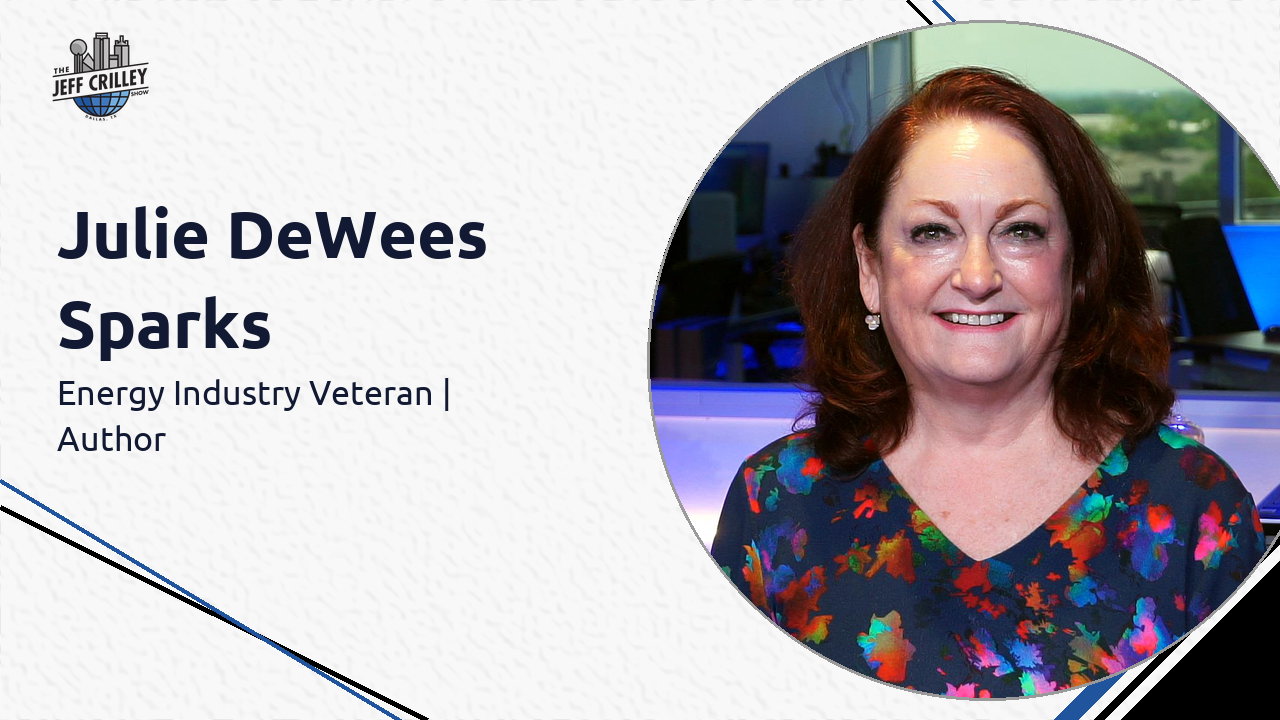
Julie DeWees Sparks, a forty-year energy industry veteran turned author, joins the Jeff Crilley Show to trace the wildcatters, ranchers, and risk-takers behind the Texas oil boom in her new book Under Texas Skies.
A Headline in San Francisco
It is sometime in January 1901, and Scott Haywood — the youngest of four brothers who have spent years touring the country as musicians — sits in a San Francisco hotel room, opening his morning newspaper. Blasted across the front page: Spindletop has come in, down in southeast Texas. The gusher is five or six days old. Haywood grabs his suitcase, wires his brother in Chicago, and sends a message that will rewrite his family's story: meet me in Beaumont, Texas.
Julie DeWees Sparks tells the Haywood story with visible delight on the set of the Jeff Crilley Show. She describes the four brothers as part of the vaudeville circuit, "although they like to say that they weren't exactly vaudeville because they didn't tell dirty jokes." They were musicians who played all across the country through the late 1890s. But when Scott Haywood spotted the oil business while the brothers were in Colorado, and then left music entirely once they reached California, the family pivoted toward a different kind of stage — the oil fields of Bakersfield, and then Texas.
The anecdote captures what Sparks does throughout her new book, Under Texas Skies: Oil, Ranches & Dreams That Shaped a State. She threads together the personal, the accidental, and the audacious to show how Texas became what it is.
From LSU to Getty Oil
Sparks did not set out to become an oil industry lifer. She graduated from LSU, moved to Houston, and landed her first job interview at Getty Oil Company. "I didn't really expect to get into the oil business," she said, "but first job interview I had was with Getty Oil Company, and it was a fantastic company. I learned so much, I had a number of great mentors." She stayed in the industry for four decades.
The 1980s crash tested her early. "That was my first job and I was young and I was seeing all these people around me that were getting laid off and prices were, you know, crashing and it was just a — it was a very scary time," she recalled. She survived the layoffs, picked up another position in 1986, and kept going. "I loved it," she said simply. "It's a good good industry."
A Library at Home
The spark that ignited Under Texas Skies was not a boardroom epiphany but a room in her own house. Sparks married a native-born Texan whose father had amassed a personal library of Texas history, oil field history, and ranching history. "It was always just a room that you know was neat and you know walked," she said, but when she started thinking about writing, she looked at the shelves differently. "My initial research was at home, just reading books from his library, making notes and studying on it. And that's what got me started."
Wildcatters and Dry Holes
What Sparks found in her research was a cast of characters defined by appetite for risk. Monty Moncrief, the Fort Worth oil man she identifies as loosely the basis for the character John Hamm plays in the television series Landman, drilled twenty-nine dry holes before hitting the discovery well for Gregg County in the East Texas oil field. Sid Richardson, one of her favorites, went through a real downturn after early success, borrowing money from friends before rebuilding his fortune — a fortune that eventually seeded the Bass Brothers' wealth.
"These guys, they put all their risk in into these things," she said. "I'm not a risk taker and I feel like if I had drilled 29 dry holes, I probably would have quit. But they didn't." The book tracks Clint Murchison, Richardson's best friend from Athens, Texas. It profiles Hal Booty in Houston and Glen McCarthy, who built the Shamrock Hotel. And it circles back to her own childhood memories — her father driving visitors around White Rock Lake to see the H. L. Hunt mansion. "It was on everybody's stop," she said.
Oil, Ranches, and the Stories Between
One of the book's surprises, even to Sparks herself, was how the ranching narratives muscled their way in. "As I was writing about all these big oil discoveries, the ranching aspect just had to be — the story had to be told," she said. "So many big oil fields were found on ranches, and I found that the ranching stories were every bit as good, if not better than some of the wildcat stories." The book's cover illustration features the Santa Rita well number two, the discovery well for the Permian Basin in 1923 — still one of the largest oil-producing basins in the world.
Sparks was clear about what the book is not. "It is not a technical book and it's not political," she said. "Somebody read it and they actually thought I was an engineer, I'm not. But I spent all of my time working with engineers and geologists and geophysicists, I learned a lot."
Hope at the Height of the Depression
Sparks placed the East Texas oil field discovery of 1930 at the emotional center of her argument for why these stories matter beyond the industry. "That was the height of the depression," she said. "Everybody came to East Texas. They wanted a piece of it because there was nothing in the rest of the country, and there was something here." The famous images of Kilgore, oil rigs packed side by side, were not just spectacles of extraction — they were signs of possibility. "It gave hope to people."
The philanthropy that followed is what she returns to again and again. "So many of them that did make money were very philanthropic, and they built our universities. We've got libraries, museums, hospitals. So many of them turned their good fortune around and shared it with the rest of the state."
A Book for This Moment
Under Texas Skies arrives at a moment when the mythology of Texas oil is freshly visible in popular culture, from Landman on television to ongoing debates about the energy industry's future. But Sparks's project is less about mythology than about the specific, often quirky human stories underneath it — vaudeville brothers who pivoted to wildcatting, mansions that were a mandatory stop on Dallas driving tours, a man who drilled twenty-nine dry holes and kept going. The book, published by Texas A&M University Press, is available at texas1836.org and on Amazon.
Julie DeWees Sparks is the author of Under Texas Skies: Oil, Ranches & Dreams That Shaped a State (Texas A&M University Press, March 2026). After forty years in the energy industry, she chronicles the oil legends, ranching dynasties, and risk-takers who helped build Texas. Learn more at texas1836.org. This episode was recorded at the Jeff Crilley Show studio in Dallas.
Key Topics
- the Spindletop discovery and its global impact
- famous Texas oil families and wildcatters
- the 1980s oil bust
- ranching and oil field connections
- the Haywood brothers' vaudeville-to-oil story
- Landman TV show and real-life inspirations
- Texas oil philanthropy
- writing Under Texas Skies
About the Guest
Julie DeWees Sparks is a forty-year energy industry veteran who began her career at Getty Oil Company and went on to work alongside engineers, geologists, and geophysicists across the Texas oil patch. She is the author of Under Texas Skies, a narrative history that interweaves the state's oil discoveries, ranching heritage, and the colorful personalities who shaped modern Texas.
Episode Timestamps
- 01:27 – Spindletop changed the world — oil made the automobile economically feasible
- 02:16 – Julie's career begins at Getty Oil Company
- 02:41 – Surviving the 1980s oil bust as a young professional
- 03:28 – Texas 1836 — the domain name and Texas independence
- 04:12 – Ranching stories rival the wildcat tales
- 04:42 – Name-dropping Texas oil royalty: Richardson, Murchison, Moncrief, the Hunts
- 05:13 – The Haywood brothers: from vaudeville to Spindletop
- 06:13 – The Santa Rita well and the Permian Basin discovery
- 08:44 – Monty Moncrief's 29 dry holes and the real story behind Landman
Watch, Listen & Connect
Subscribe for more episodes!
Episode Chapters
- 00:00 – Introduction
- 01:27 – Meet Julie DeWees Sparks
- 01:46 – How Spindletop Changed the World
- 02:15 – Julie's Career in Oil and Gas
- 02:29 – Surviving the 1980s Oil Bust
- 03:28 – What Readers Will Find in Under Texas Skies
- 04:10 – Famous Texas Oil Families
- 05:13 – The Haywood Brothers: From Vaudeville to Oil
- 06:13 – The Book Cover and the Permian Basin
- 06:40 – A Love of Texas History
- 07:23 – Research Surprises and the Writing Process
- 08:34 – Wildcatters and Risk Takers
- 09:57 – Oil's Legacy of Hope and Philanthropy
- 11:06 – Where to Get the Book