The First New U.S. Oil Refinery in Fifty-Two Years Took Twelve Years to Permit
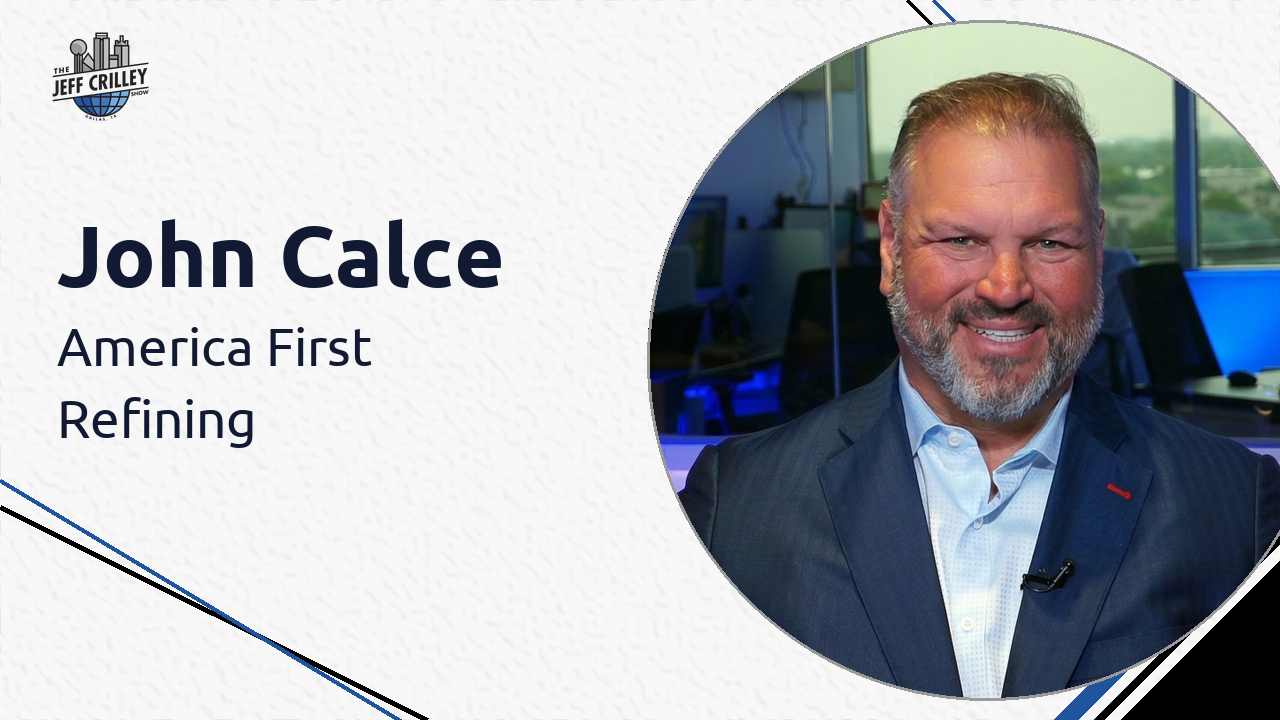
John Calce, CEO and founder of America First Refining, tells the story of how a long-shot bet on shale oil became a $4 billion refinery project in Brownsville, Texas.
The Pizza Oven Explanation
John Calce leans forward and starts talking about pizza. He is trying to explain why the United States, the world's largest oil producer, cannot refine enough of its own crude — and he has settled on an analogy involving ovens. "A refinery is like a big oven. You're cooking oil for lack of a better description," he told host Jeff Crilley. "If you have a pizza oven, you're gonna set it up at a thousand degrees to make pizzas. And that's great for pizza dough. Think of that as heavy oil or traditional oil."
Then the kicker: "If you want to bake a cookie and you put it in a pizza oven, it burns up. If you put a pizza dough in a cookie oven, you never get pizza." The oil refinery, Calce explained, works the same way. America's existing refineries were built decades ago, tuned to process heavy crude from the Gulf Coast and foreign imports. The shale oil now gushing from the Permian Basin is lighter, different stuff — and nobody built an oven for it.
That gap is the reason Calce spent twelve years of his life pushing a single project through bureaucratic quicksand. Now, with permits in hand, a commercial partner signed, and a presidential mention on Truth Social, America First Refining is preparing to build the first new oil refinery in the United States in more than half a century.
A Bet Placed in 2015
Calce started the company in 2015 with a couple of partners and a thesis: American shale production was going to surge, and the country's refining capacity would not keep up. "This at the time, The US was producing maybe 5,000,000 barrels or so a day, and we thought there was a lot more growth to come," he recalled. Today, domestic production sits around 13 to 14 million barrels per day.
He and his partners headed to Austin to begin the permitting process, meeting with the Texas Commission on Environmental Quality and the governor's office. The message they received was encouraging. "They said, John, this is great. It'll take you eighteen months to get a permit," Calce said. That eighteen-month estimate proved wildly optimistic.
Seven Years for One Permit
The permitting process stretched from 2015 to 2022 — seven full years. "Turns out it's hard. As I learned the hard way," Calce said, with the weary humor of someone who has told the story enough times to laugh about it. The broader journey from concept to construction has now spanned a dozen years.
When Crilley congratulated him on his persistence, Calce acknowledged the long road but kept the focus on what came next: finding a commercial partner to make the project financially viable. That partner turned out to be India's Reliance Group, which came in as a minority investor with an agreement to purchase more than 80 percent of the refinery's output. A KXAN Austin report played during the show noted that University of Houston professor Ed Hurst called this investment the factor that made the project possible.
President Donald Trump announced the Brownsville project on Truth Social. Port of Brownsville leaders described it as a $3 to $4 billion endeavor expected to create roughly 500 direct jobs — one piece of a broader $20 billion pipeline of projects eyeing the port.
Building the Right Oven
The core of Calce's pitch is technical but straightforward. American refineries were designed for heavy crude. Shale oil is light — 47° API gravity, to use the industry measure. Processing light crude in a heavy-crude refinery is the cookie-in-the-pizza-oven problem. "We recognize that all the way back in 2015 and realize we needed to build an oven specific for shale oil," Calce said. "That's what we permitted, that's what we designed."
America First Refining's Brownsville facility is engineered to process 100 percent domestic light shale oil, with plans to handle 60 million barrels of crude per year. Calce expects all major units on the ground by 2028 and a first full year of commercial operations in 2029. "I wish it was tomorrow. It's only been twelve years so far, but we are we're going as fast as we can," he said.
Crude Goes to Asia, Gasoline Comes Back
Calce made a case for urgency that went well beyond his own refinery. The United States exports roughly 5 million barrels of crude per day, and much of it follows a path he finds absurd. "A lot of that oil goes from The US Gulf Coast over to Asia because they had built refineries in Asia. So Korea, China, etcetera. They refined US oil into gasoline and then guess where they ship that gasoline back to?" he said. "Back to California. California imports 70% of their gasoline."
He argued the country needs not just more refineries but also expanded export infrastructure — deeper-water loading facilities for the massive vessels called VLCCs, the very large crude carriers that hold 2 million barrels each. He pointed to plans for a new offshore loading facility near the Port of Corpus Christi as a step in that direction. "We should be processing more of it here at home. Let's export high quality, high priced refined products," Calce said.
Energy as National Security
Asked whether the national mood on domestic energy production is shifting, Calce framed the issue in blunt terms. "If you're out of gasoline, you can't turn the lights on, you can't put diesel in the truck to haul the goods around, we have a real problem," he said. He described the correct strategy as "all the above" — oil, gas, nuclear, and yes, electric vehicles, which themselves require electricity generated largely from natural gas.
"The world needs more energy. We're growing," Calce said. "People that are developing nations, they want to have a car, want to cook, they want to have electricity all the time. The US is blessed to have an abundance of natural resources, so we should pursue an all the above strategy. And in doing so, we actually enhance our national security."
Three More Years
Twelve years in, with construction on the horizon, Calce offered no victory lap. He credited the TCEQ, the governor's office, his commercial partners, and his team at America First Refining. The tone was less celebration than relief — the grinding bureaucratic work is done, and now the grinding physical work begins. "In 2028, we should have all of our large units on the ground and being assembled in Brownsville with our first full year of operations in 2029," he said. Three more years. After twelve, what's three?
John Calce is the CEO and founder of America First Refining (americafirstrefining.com), which is building the first new U.S. oil refinery in over fifty years at the Port of Brownsville, Texas. This episode was recorded at The Jeff Crilley Show studios in Dallas, Texas.
Key Topics
- the first U.S. refinery in 52 years
- the shale oil revolution
- refining heavy versus light crude
- the Port of Brownsville project
- energy independence and national security
- fuel export and import dynamics
About the Guest
John Calce is the CEO and founder of America First Refining. With over a decade of experience navigating the complex legislative and environmental landscape of the energy sector, he is currently leading the development of the first major oil refinery project in the United States since the 1970s.
Episode Timestamps
- 01:35 – The First New Refinery in 52 Years
- 03:04 – The 12-Year Permitting Odyssey
- 04:52 – India's Reliance Group Partnership
- 06:06 – Why Refineries Are Like Pizza Ovens
- 08:03 – The Irony of U.S. Gasoline Imports
- 10:11 – An "All the Above" Energy Strategy
- 11:40 – Project Timeline for 2029 Operations
Watch, Listen & Connect
Subscribe for more episodes!
Episode Chapters
- 00:00 – Introduction
- 01:23 – Why No New Refineries in 50 Years
- 01:55 – The Shale Revolution Changes Everything
- 02:48 – A 12-Year Journey to Get Permitted
- 03:53 – KXAN News Report on the Brownsville Project
- 05:43 – Light Crude vs. Heavy Crude Explained
- 07:18 – The Case for More U.S. Refining Capacity
- 09:25 – Energy Independence and National Security
- 09:49 – EVs, Nuclear, and an All-of-the-Above Strategy
- 10:50 – Timeline to First Operations
- 11:14 – Final Thoughts and Closing