
Matt Rosen on The Jeff Crilley Show
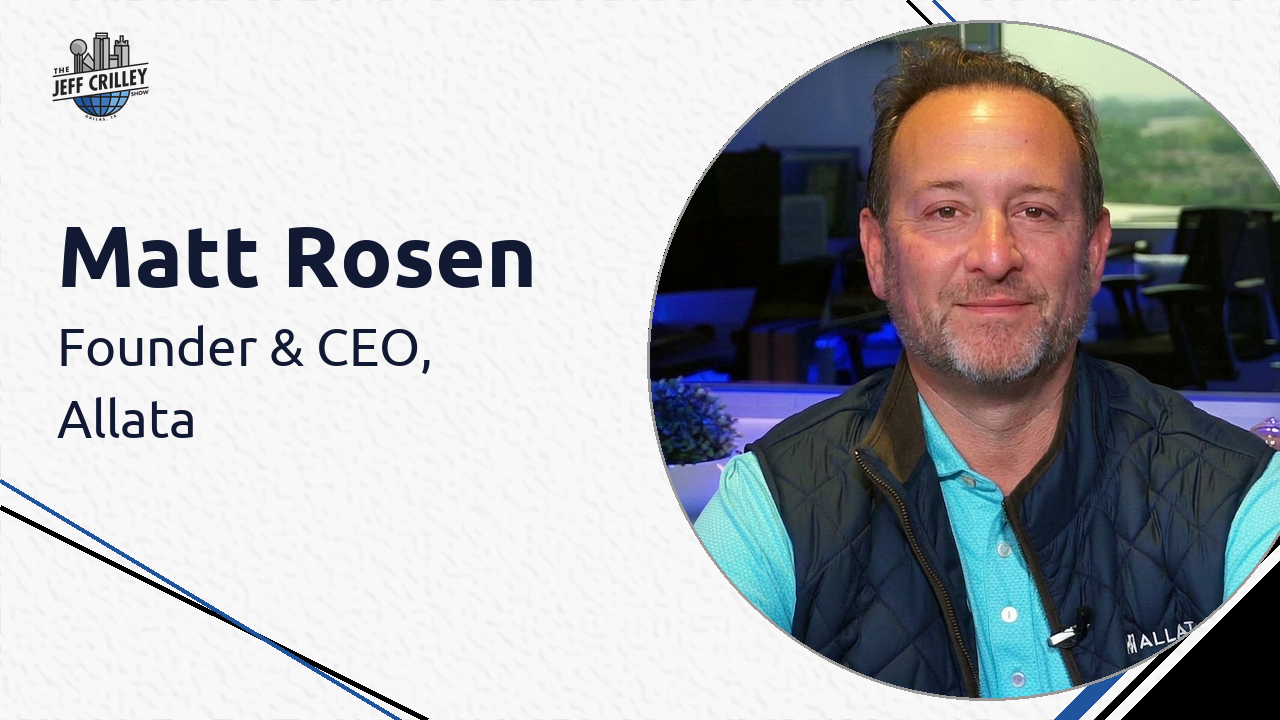
Matt Rosen, founder and CEO of Allata and host of The Grit Mindset podcast, explains how his firm ate its own cooking on AI — and why the gap between companies that adopt and those that don't is widening fast.
The Review That Changed Everything
At Allata, a 350-person technology consulting firm, employee performance reviews used to be a grueling ritual. A complex Excel workbook laid out expectations for every level. Managers gathered 360-degree feedback, then wrote a word narrative for each employee — a process that consumed eight to ten hours per person. The reviews, after all that labor, often weren't very good.
Then, in late 2022, Matt Rosen and his team turned AI on the problem. They built internal tooling that helped reviewers collaborate with AI to produce the same deliverable. The time dropped to thirty minutes. "We estimated savings of, like, half a million a year across our organization, which is huge, and it gives people — you know, and the reviews are way better, and people like them more," Rosen told Jeff Crilley during his third appearance on The Jeff Crilley Show.
The employee review project wasn't just an efficiency win. It became the proof point that reshaped how Allata sells — and a case study in what happens when a company takes its own medicine before prescribing it to clients.
From Custom Dev to AI
Rosen and Crilley first crossed paths during the height of COVID, when Allata was still known primarily as a custom development and digital consulting firm. In the six years since, the company's identity has shifted dramatically. "Now that narrative and what we do is totally pivot over to AI and data and helping companies really adopt AI from an enterprise level, integrating all their systems and documents and really helping them unlock the knowledge they have internally," Rosen explained.
The pivot didn't mean abandoning the firm's roots. Allata still builds custom software, but the work is now AI-driven. "We're developing solutions for people faster than ever before," Rosen said. The company serves clients ranging from startups to the Fortune 500, though Rosen pegged the sweet spot at firms generating $250 million to $5 billion in revenue — organizations with strong leadership teams that see technology as a strategic enabler.
Proving It on Themselves First
Rosen was blunt about the noise in the AI consulting space. "Every consulting firm, every software firm now has AI. In fact, businesses that don't even do AI say they do AI," he said. "It's kinda like the ecommerce days when I started in this business. Everything had e in front of it, little e and, you know, or a .com behind it, and it was worth billions of dollars."
So Allata decided to differentiate through proof. After the employee review success, the team enabled other parts of the business with the same AI platform. Then they did something simple but effective: they showed clients what they'd done. "Instead of just saying, we do AI, we're like, let me show you what we've done. Let me show you the business results it had, so that we had a lot more credibility in going to our clients and say, we can help you too," Rosen said.
The internal AI accelerator became a daily tool for Rosen himself. Allata built what they call an "Alata bot" — named by David Romeo, the company's VP of innovation, who Rosen noted "is not a marketing guy." Every morning, Rosen logs in and asks it about the sales pipeline, project statuses, and his calendar. It scans the CRM, the time and billing system, and his Outlook inbox. "What would have taken me twenty, thirty minutes to search through systems in my inbox," he said, now arrives automatically. "It eliminates the need for me to log in to all these different things and then I can focus on the important things which is serving our clients or people and ultimately my family."
Startups That Couldn't Have Existed Before
Rosen highlighted two recent projects that illustrated AI's impact on development speed and cost. The first was Relay, a software tool for the multifamily real estate space that helps operators get money faster for insurance claims and construction draws. The second was Sportsmo, an in-game micro-donation platform for NIL that helps schools without deep-pocketed boosters raise money from alumni.
"Both of those application development initiatives would have cost in the millions of dollars, and we will do it well under what it would have normally cost using AI to help speed the development," Rosen said. "So it allowed both of these entrepreneurs to get their dreams to market faster and out in the marketplace so they could start getting clients on them and we would not have been able to do that before the advent of that technology."
He also offered a more personal example. Using a tool called Lovable — which runs on Anthropic models — Rosen built a family meal planner for his wife, a doctor, and their two teenage daughters. The app stores recipes with health scores, lets the family vote on meals, and generates a shopping list that deducts what's already in the pantry. "People have said I should take it to market as an app, and I'm not a b to c guy," he said with a laugh.
The Haves and the Have-Nots
Rosen pushed back on the doom-and-gloom narrative around AI, placing some blame on the industry's own leaders. "The people that are driving AI, that's the Sam Altmans, the Dario Amodeis that, you know, run Anthropic, they've done a terrible job on the narrative," he said. "They've talked negatively so much about it without a solution of, like, what's the good AI is gonna bring?"
He acknowledged that jobs will be lost but argued the picture is more nuanced. "Humans crave being around one another," he said. "Starbucks actually tried to automate everything, and they're actually hiring more baristas and bringing people because they want people to sit in the store. People want that human interaction." The real concern, in his view, is the growing divide between those who adopt AI and those who don't — a gap he sees across businesses, schools, and even individual students. His daughter's sixth-grade school blocks all AI tools. "These kids are growing up in a generation where they're gonna need to know how these tools work," he said. "I think colleges and universities need to take a hard look at the world they're getting kids ready for."
Own Your Platform
Rosen's advice to business owners centered on one principle: don't hand your entire AI strategy to a single provider. He compared the current moment to the browser wars of the late 1990s. "Right now, people are using three, four different tools. No one knows which one's gonna win," he said. If a company has tied itself entirely to one platform and that platform goes down, the business takes the hit.
Allata's approach is to help companies build their own AI environments — with hooks to multiple models — so that data stays secure and operations aren't dependent on any one vendor. "I like taking destiny into your own hands," Rosen said. "Nobody knows who's gonna win this race. And it's gonna be a really interesting one to watch."
The Race Is Already On
Rosen, who also hosts The Grit Mindset podcast — which was recording its 60th episode right after this taping — framed the AI moment as something closer to the arrival of the automobile than the latest software upgrade. The comparison isn't just about disruption; it's about inevitability. "This technology is here to stay. You cannot put your head in the sand," he said. "The haves and have nots in AI, the gap is growing wider and wider, and this is not a fad."
His parting thought was characteristically direct: "You can use AI to teach you AI." For anyone still wondering where to start, that alone might be worth the price of admission — which, as Rosen pointed out, is free.
Matt Rosen is the founder and CEO of Allata, a technology consulting firm helping companies adopt AI at the enterprise level, and host of The Grit Mindset podcast. Learn more at allata.com. This episode was recorded at The Jeff Crilley Show studios in Dallas.
Watch, Listen & Connect
Subscribe for more episodes!
Episode Chapters
- 00:00 – Introduction
- 01:19 – Meet Matt Rosen, CEO of Allata
- 01:44 – How Allata Evolved from Custom Dev to AI
- 02:18 – Standing Out in the AI Gold Rush
- 03:03 – AI-Powered Employee Reviews Save Big
- 04:12 – Allata's Ideal Clients and Approach
- 05:06 – AI-Driven Startup Success Stories
- 06:12 – A Family Meal Planner Built with AI
- 07:16 – The Grit Mindset Podcast
- 08:01 – Debunking AI Myths and Misconceptions
- 10:35 – Staying Ahead with AI Tools Daily
- 11:23 – Are Colleges Preparing Students for AI?
- 13:05 – Advice for Business Owners Adopting AI
- 14:34 – Closing Thoughts and Where to Find Allata